
Chiropractic Care for Lower and Upper Back Pain: A Personalized Approach to Relief and Better Movement

Back pain can affect much more than your ability to bend, lift, or move comfortably. Whether you’re dealing with persistent lower back pain, stiffness between the shoulder blades, or recurring discomfort that seems to return with work and everyday activity, it can interfere with sleep, exercise, concentration, and the things you need to do each day.
At Next Level Health & Rehab, our approach to chiropractic care for back pain is personalized and movement-focused. Rather than treating every case the same way, we consider your symptoms, mobility, daily demands, injury history, and movement patterns when determining an appropriate plan.
Treatment may combine chiropractic adjustments, soft tissue therapy, functional movement strategies, and practical recommendations designed to help you move more comfortably and build toward lasting improvement.
TABLE OF CONTENTS
Understanding the Types of Back Pain We Treat
“Back pain” is a broad term. Where you feel discomfort, what movements trigger it, how long it has been present, and whether other symptoms are involved can all help determine the appropriate approach to care.
Two of the most common areas are the lumbar spine (lower back) and thoracic spine (upper and mid-back).

Upper Back Pain
Upper and mid-back discomfort often involves the thoracic spine, ribs, shoulder blades, and surrounding muscles.
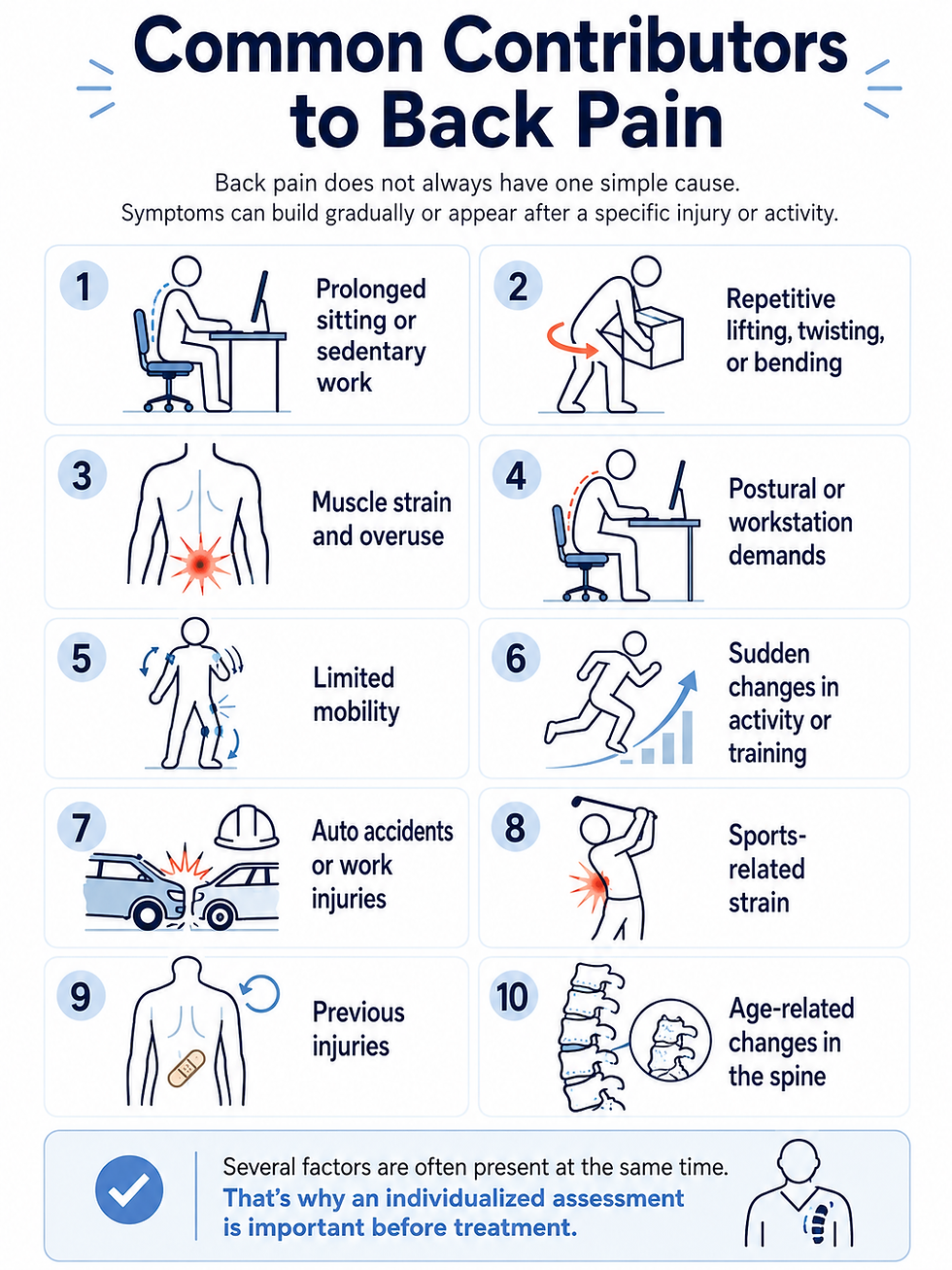
Contributing factors may include:
Prolonged desk or computer work
Repetitive upper-body activity
Postural strain
Limited thoracic mobility
Muscle fatigue or tension
Driving for extended periods
Training or occupational demands
Some people describe upper-back pain as stiffness, pressure, aching, or a pulling or burning sensation between the shoulder blades.
Lower Back Pain
The lower back supports much of the load associated with sitting, standing, bending, lifting, and everyday movement. Because of these demands, it is one of the most common areas for musculoskeletal pain.
Lower back discomfort may be associated with:
Repetitive lifting, bending, or twisting
Prolonged sitting or reduced activity
Muscle strain or overuse
Limited hip or spinal mobility
Previous injuries
Age-related or degenerative changes
Certain disc or nerve-related conditions
Symptoms can range from a dull ache or stiffness to sharper discomfort with specific movements. Some people may also experience symptoms extending into the buttocks or legs.
How Chiropractic Care for Back Pain May Help
Chiropractic care for back pain should not begin with the assumption that everyone needs the same adjustment.
Dr. Rodesha Davis (“Dr. Ro”) evaluates how the spine, joints, muscles, and surrounding movement patterns work together. The goal is to identify areas of restriction or dysfunction that may be contributing to your symptoms and develop care around your individual needs.
Depending on your evaluation, treatment may include:
Chiropractic Adjustments & Joint Mobilization

Targeted adjustments or mobilization may be used to improve movement in restricted joints and support more comfortable spinal function.
Care may help:
Improve joint mobility
Increase comfortable range of motion
Reduce mechanical stiffness
Support more efficient movement
Soft Tissue Therapy

Muscle tension and surrounding soft-tissue restrictions can contribute to back discomfort and limited movement. Soft tissue therapy may be incorporated to address tight or overworked tissues and improve mobility alongside chiropractic care. Techniques are selected according to your symptoms, comfort, and treatment goals.
Functional Movement Therapy

Feeling better is only part of the equation. Understanding how you move can be equally important.
Functional movement strategies may address:
Mobility limitations
Core and trunk control
Hip movement
Lifting mechanics
Strength and stability
Postural or movement habits
The goal is to help your body handle the demands of everyday life more effectively rather than relying solely on passive treatment.
Lower Back Pain vs. Sciatica: What’s the Difference?
Not every case of lower back pain is sciatica.
Lower back pain may remain localized around the lumbar spine and surrounding muscles. Sciatica generally describes symptoms associated with irritation of the sciatic nerve or related nerve roots, which may produce pain, tingling, numbness, or other symptoms extending through the buttock and leg.
Because radiating symptoms can have different causes, they should be properly evaluated rather than assumed to be ordinary back pain.
Experiencing symptoms that travel into your leg? Explore our guide to Chiropractic Care for Sciatica and Nerve Discomfort.
When Should You Consider Seeing a Chiropractor for Back Pain?

A chiropractic evaluation may be worth considering when back discomfort or stiffness is affecting your movement or daily routine.
You do not necessarily need to wait until discomfort becomes severe. An evaluation can help identify movement limitations and determine whether chiropractic care is appropriate for your situation. → Book Your Evaluation and Your Treatment
When Back Pain Needs Medical Attention
Back pain is common, but not every type of back pain should be managed with chiropractic treatment alone.
Seek prompt medical attention for back pain accompanied by symptoms such as:
New or progressive weakness
Loss of bowel or bladder control
Numbness around the groin or saddle region
Significant trauma
Fever or unexplained illness
Severe or rapidly worsening symptoms
Your safety comes first. If your presentation suggests that another type of evaluation or treatment is more appropriate, referral should be part of responsible care.

Supporting Your Back Between Appointments
Treatment is only one part of managing back pain. Your everyday movement and habits can also influence how your back feels.
A Whole-Body Approach to Back Pain
Back pain rarely exists in complete isolation. Hip mobility, muscle tension, movement habits, physical workload, recovery, and overall activity can all influence how your back functions.
At Next Level Health & Rehab, chiropractic care can be integrated with:
Soft Tissue Therapy to address muscle and fascial tension
Functional Movement Therapy to improve mobility, strength, and movement quality
Sports Performance & Injury Rehab for active individuals returning to training or competition
Lifestyle & Nutrition Coaching to support broader health and recovery goals
Mobile Chiropractic Services for personalized care at your home, office, gym, or other appropriate setting
Our goal is to look beyond the painful area and build a plan around how your body moves, what your lifestyle demands, and what you want to get back to doing.
Frequently Asked Questions
Can a chiropractor help with lower back pain?
Chiropractic care may be appropriate for some types of lower back pain, particularly when joint mobility, stiffness, muscle tension, or movement limitations are involved. An evaluation helps determine whether chiropractic treatment is appropriate for your individual symptoms.
Can chiropractic care help upper back pain?
Chiropractic care may help address joint restrictions, stiffness, and movement limitations affecting the thoracic spine and surrounding areas. Soft tissue therapy or movement-based treatment may also be incorporated depending on your needs.
How do I know if my back pain is sciatica?
Sciatica commonly involves symptoms that extend from the lower back or buttock into the leg and may include pain, tingling, numbness, or other nerve-related sensations. Because several conditions can cause radiating symptoms, an evaluation is important for determining the appropriate next step.
How many chiropractic visits will I need for back pain?
The number and frequency of visits depend on factors such as your symptoms, how long the problem has been present, your activity demands, examination findings, and response to care. Treatment recommendations should be individualized rather than based on a predetermined number of visits.
Explore Related Topics
Continue learning about conditions and services related to back pain:
Chiropractic Care for Back Pain in Baltimore & Harford County
Next Level Health & Rehab provides personalized chiropractic care for patients throughout Baltimore County and Harford County, Maryland.
Our office is conveniently located in Hunt Valley, MD, providing in-office chiropractic care for patients from Cockeysville, Phoenix, Towson, Timonium, and surrounding Baltimore County communities.
For greater flexibility, mobile chiropractic care is also available throughout eligible areas of Baltimore County and Harford County, bringing personalized treatment directly to your home, workplace, gym, or other appropriate setting.
Whether you choose in-office or mobile care, your treatment is built around the same goal: helping you move more comfortably and confidently.
Take the Next Step Toward Better Movement
You should not have to structure your entire day around your back. If persistent stiffness, limited mobility, or recurring back pain is interfering with the way you work, train, sleep, or move, we’re here to help you better understand your options and determine an appropriate next step.


